Category Archives: Uncategorized

Maybe You Should Talk To Someone {Book Takeaways}

Christi Hegstad July 25th, 2019

I recently received Lori Gottlieb’s new book, Maybe You Should Talk To Someone. As soon as I started reading, I predicted I would have a tough time putting it down.

That prediction (which I promptly posted on Instagram) turned out to be 100% accurate.

What an incredible read! Gottlieb, a therapist also in therapy herself, provides a beautiful look into the power of the human spirit. Insightful, witty, relatable, and real, she honestly had me laughing out loud one minute and wiping away tears the next.

If I could capture the book’s essence in a few words, these come to mind immediately:

Humanity.

Perspective.

Compassion.

Resilience.

Courage.

This is one of the best books I’ve read all year, offering a powerful reminder that regardless of appearances, we all deal with challenges we may hesitate to share. Her stories demonstrate what a life-changing difference compassion and empathy – both for others *and* for ourselves – can make.

This one will stay with me for a long time – I highly recommend it!

What other books have reminded you of the inspiring power of the human spirit?

Christi Hegstad, PhD, PCC is an executive coach helping you design your ideal vision and achieve it with clarity, confidence, and meaningful action! Join our community: Click here and fill in the blue box or send us an email

A Quick Mid-Summer Motivation Boost

Christi Hegstad July 21st, 2019

Hardly anyone I know experiences the so-called ‘lazy, hazy days of summer.’ A few have, however, mentioned feeling a bit less motivated toward their goals lately.

Whether due to vacation, increasingly warm days, or for no recognizable reason, experiencing a bit of a lull at this time of year is certainly not uncommon.

It may be that you’ve diligently worked toward your goals all year and need a little break.

Or it may be that you simply need a motivation boost.

This week, remember why you started.

What excited you about the goal when you initially set it?

How will achievement of the goal impact your quality of life? How will it impact others’ lives?

What will be different when you accomplish your goal? What will you be able to say about / to yourself that you cannot currently say?

What is the purpose of the goal?

Returning to your ‘why’ is one of the greatest motivators I know. Take a few quiet moments this week to reconnect with yours!

Christi Hegstad, PhD, PCC is an executive coach helping you design your ideal vision and achieve it with clarity, confidence, and meaningful action! Join our community: Click here and fill in the blue box or send us an email


Leveraging Quiet Times In Your Business Cycle

Christi Hegstad July 18th, 2019

Depending on your industry, you may find work a bit quieter in July. How will you make the most of this time?

This quiet time (or any other that occurs in your business cycle) can be a fantastic opportunity to focus on your personal and professional development. For example, you could utilize the time to:

* Read books

* Enroll in a class or conference

* Work with a coach

* Journal

* Listen to growth-oriented podcasts

* Schedule ‘thinking time’ (check out Bill Gates’ example)

* Plan for an outstanding remainder of 2019

* Mastermind with peers and colleagues

* Watch a few TED Talks

* Go for walks without headphones

Of course, rest, relaxation, and vacations can be rejuvenating as well!

What other ideas for personal growth would you add to this list?

Christi Hegstad, PhD, PCC is an executive coach helping leaders achieve boldly with clarity, confidence, and meaningful action! Join our community: Click here and fill in the blue box or send us an email


How To Be CEO Of Your Own Life

Christi Hegstad July 16th, 2019

Earlier this year, I began working with a client who had reached extraordinary success in her business but had begun feeling like an underperformer in life. She sought coaching in order to get a better handle on her time, relationships, health, and other key areas – while still keeping the business top-notch.

I suggested that the strategies and skills she utilized to elevate her business could, with just a bit of shifting, also elevate her life. We took some of her greatest strengths and mindset practices from her CEO role and applied them to other areas of her life, leading to both immediate and lasting results.

You might be surprised how transferable your skills are – whether between jobs, between home and work, between parenting and leadership. Below you’ll discover 5 concepts I have found especially helpful both in leading my company and in leading my life!


1. Be a visionary.

Where do you see yourself, your family, your department or business a year from now? How about 5 years from now? Crafting a compelling and magnetic vision clears the path and makes designing the action plan so much easier. Hold your vision high to avoid getting lost in the weeds.


2. Set – and track – meaningful goals.

Once you have that clear and compelling vision, make sure you’re moving toward it by regularly assessing progress on your big-picture goals. A Weekly Review + Planning Session, coupled with a daily reminder of your vision and goals, can be instrumental in this.

unnamed-4


3. Surround yourself with brilliance.

When I was 6 years old, I cut my own hair and learned a very valuable lesson: Some things are best left to the experts! 🙂 Whether it’s the people you hire or those you go to for advice and encouragement, surround yourself with inspiration and brilliance.


4. Coach vs. dictate.

In business, family life, even when talking to yourself, you can greatly impact action and a sense of ownership with the words you choose. I bet you’ll see a difference, for example, between ‘How would doing this positively impact your life?’ and ‘Because I said so.’


5. Have some FUN already!

It’s easy to get caught up in the tasks that keep everything afloat, but doing so to the extreme is also a good way to hit burnout. Periodically change your scenery. Turn up the music. Bring a 96-pack of crayons and a stack of paper into the kitchen or break room. Schedule fun if you need to!


How else can you embody the role of CEO in your own life? Share your ideas on Instagram, Facebook, or below!

I’m here to help you clarify your vision and achieve it with confidence!  Contact me to discuss coaching possibilities.


Your Excellent Daily Habit

Christi Hegstad July 14th, 2019

If I asked what habits you’ve developed that you’d like to change, I imagine a few would come to mind.

But what if I asked about the habits you’ve developed that you want to make sure you sustain? The ones that support your continuous growth, positive mindset, and purposeful success?

This week, commit to starting – or continuing – one excellent daily habit.

A few ideas to prompt your thoughts:

What daily habit will you start or continue this week? Inspire us all by sharing on Instagram or Facebook!

Receive coaching tips, special offers, and proven strategies for succeeding with clarity and confidence! Click here and fill in the blue box or send us an email


Taming The Massive To-Do List With One Simple Practice

Christi Hegstad July 7th, 2019

What strategies help you achieve a sense of fulfillment each day?

One of my favorites is what I call the Daily Top 3.

Instead of becoming overwhelmed by a massive to-do list or continually checking little things off but not making headway on important goals, the Daily Top 3 can help you stay focused on the big picture while addressing current necessities.

This week, implement the Daily Top 3.

As soon as possible in the morning (or even the night before), look at your goals for the week, appointments for the day, deadlines, and to-do’s.

Taking all of those into account, select your 3 most important tasks for the day – the 3 that, even if the rest of the day goes haywire, will allow you to go to bed with a sense of accomplishment.

Then (and this is important!), separate those 3 items from the rest of your to-do list. Write them on a sticky note or your office white board. When those high-proirity items are complete, feel free to wander back to the massive list and see what else you can address.

This may require some experimentation, and yes, other things may arise throughout the day that need your attention. But by developing a habit of prioritization, you’ll begin to more naturally discern between urgent and important, and will likely see an improvement in your focus as well. Let me know how it goes!

Get coaching tips, special offers, and become part of our positive, purposeful community! Click here and fill in the blue box or send us an email

Decluttering Beyond ‘Stuff’

Christi Hegstad July 4th, 2019

Have you ever dropped off a bag (or trunk-load) (or truck bed) of stuff at a donation site after decluttering?

If so, you know the feelings of lightness, clarity, and spaciousness that can come with letting go of excess.

Early in my business I facilitated numerous decluttering workshops, viewing the process from this perspective: Discern your vision, values, and purpose, then clear away obstacles that keep you from fulfilling them.

And that doesn’t just mean ‘stuff.’ You can declutter many aspects of work and life in a similar way, and with similar benefits.

This week, declutter your screen usage.

One area that overwhelms many is online involvement: email, social media, and the like.

This week, explore your relationship with technology – perhaps choosing one area that feels particularly frustrating or time-consuming. Start by clarifying your purpose for engaging in that platform.

Then, ask yourself what would enhance your experience. Creating a schedule so you don’t feel tied to your phone? Before logging in, pausing to ask yourself what you intend to accomplish? Taking a break and seeing what you notice?

Examine how your screen usage contributes to or takes away from your values and vision for your life, and experiment with possibilities. For further discussion, click here to read my thoughts from the book Digital Minimalism, which has transformed the way I use InstagramFacebook, and screens in general!

Get coaching tips, special offers, and become part of our positive, purposeful community! Click here and fill in the blue box or send us an email

Does Your Online Experience Honor Your Values?

Christi Hegstad June 30th, 2019

Some people discover an incredible band, buy all their albums, attend their concerts, and watch for everything new they create.

That’s kind of how I am with author Cal Newport. ?

I first connected with Newport when he spoke at a coaching conference I attended a few years ago. Since then, I have read, written about, and shared his books all over the place. I am what you might call a super-fan.

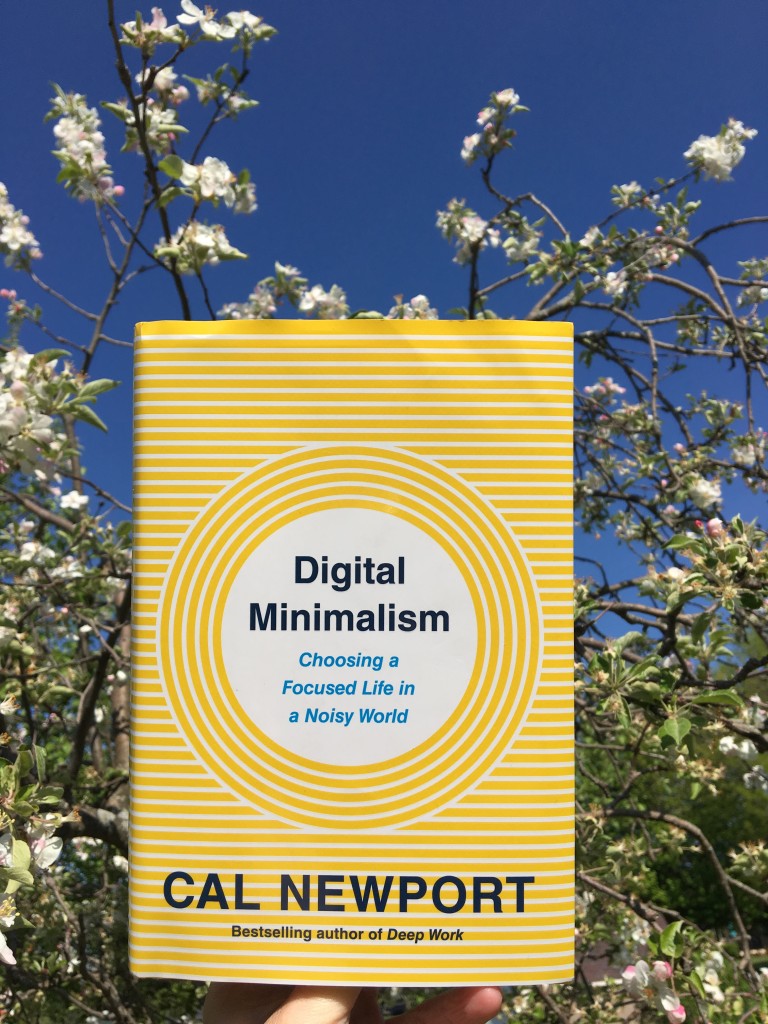
His latest book, Digital Minimalism, arrived at a time when I actually didn’t think I needed it. I have felt pretty intentional with my screen time lately. But, in typical Newport fashion, he made me look at my practices from an entirely new perspective and challenged me to alter my behavior in order to live and work with greater intention.

IMG_3499

Newport is an associate professor of computer science at Georgetown and the author of Deep Work, a WSJ best-seller and one of my all-time favorite books. But don’t bother looking him up on Twitter or Facebook – he does not have a presence there. After you read Digital Minimalism, you may choose to let go of yours, too – or at least change the way you use them.

Newport doesn’t guilt-trip or judge those who spend extensive time online, but he doesn’t sugarcoat things, either. Research on the effects of social media – just like social media itself – is new, but doesn’t look promising: We compulsively check our devices. We are losing our ability for solitude, uninterrupted thought, and extended focus to accomplish challenging tasks. We – including children – are seeing an epidemic of anxiety, loneliness, and social comparison.

“People feel as though they are ceding more and more of their autonomy when it comes to deciding how they direct their attention,” he writes. “They joined [social media platforms] to stay in touch with friends across the country, and then ended up unable to maintain an uninterrupted conversation with the friend sitting across the table.”

The internet likely isn’t going anywhere, nor do we necessarily want it to. But we do need to reclaim our ability to decide how we use it. Below, I share my two biggest takeaways from the book (and believe me, I had many).

Core Values Coffee Paper

1. Let Your Core Values Guide You.

Simply implementing a few hacks (turning off notifications, for example) isn’t enough to actually change our experience. “What you need instead,” shares Newport, “is a full-fledged philosophy of technology use, rooted in your deep values.”

I couldn’t agree more. I cannot think of a single aspect of work or life that isn’t made stronger – and in many cases, easier – by knowing our core values, then acting in accordance with them. In the case of digital presence, Newport offers a few questions to ask yourself before hopping back online:

a. Does this technology directly support something I deeply value?

b. If yes, is this technology the BEST way to support this value?

c. If yes, how am I going to use this technology going forward to maximize its value and minimize its harms?

You might think clicking “Like” effectively lets your cousin know you are happy about his award, for example. But what if you sent a handwritten note instead? What if you invited him out for a celebratory lunch? Consider taking a conscious step off of autopilot, reassessing your values, then moving forward with clarity and integrity.

Candle Flower cropped

2. Be Intentional.

Take an honest look at the role of social media in your life, then intentionally decide how – and how much – life energy (time, mental capacity, and so on) you will dedicate to it.

This may require a significant mindset shift, but a highly worthwhile one. Less FOMO, less comparison, less worrying about whether something you posted was taken the wrong way. More focus, more meaningful accomplishment, greater autonomy.

For a while, I thought, “But I’m a business owner. I have to have a steady online presence or potential clients won’t know about me.” In reality, however, the time I need to spend online for business reasons is minimal, yet I often found myself lost in the rabbit-hole of distraction. When used well, social media can serve as a wonderful tool for connection; on the other side of the coin, it can also promote mindlessness, procrastination, and fuel our insecurities.

Sunset Mexico Sky Ocean Palm Tree

After reading Deep Work, I changed the way I utilize my time; after Digital Minimalism, I changed the way I use the internet. Both have led to powerful, positive results.

I am still active on InstagramFacebook, and LinkedIn, and I enjoy these services for connecting with family and clients, learning from others, and hopefully inspiring positive action – part of my life purpose. But I now feel much more focused and intentional with how I use these platforms, rather than hopping on any time I find myself with a few minutes to spare.

I highly recommend Digital Minimalism – as well as Deep Work, So Good They Can’t Ignore You, and pretty much anything else you can find from Cal Newport (he has appeared on many podcasts lately, too). And although he likely won’t see my praise of his work on Instagram and elsewhere, I hope that *you* benefit from this recap and recommendation. Feel free to let me know your takeaways – either from this blog or Digital Minimalism!


Get coaching tips, special offers, and become part of our positive, purposeful community! Click here and fill in the blue box or send us an email

The Toll Of Decision Fatigue

Christi Hegstad June 26th, 2019

This article was originally published by the Business Record.

My son came home from practice recently with a seemingly simple question, one I’ve answered many times before: “What’s for dinner?”

On this particular day, however, that seemingly simple question suddenly became completely unanswerable. I had no idea, and had no idea how to generate an idea. Will we cook something? If so, what? Will we go out? If so, where? Will we heat up leftovers? Call for delivery? Pour bowls of cereal and call it good?

I was completely tapped out, as if my brain had hung up a “closed” sign and left for the day. I simply could not make one more decision.

Have you experienced this? Or perhaps you have noticed the quality of your decisions decreasing as the day goes on. You are not alone; in fact, there is now a body of research around the concept of “decision fatigue” and the toll it can take on us as individuals, professionals, leaders, moms.

And it’s sneaky. “It’s different from ordinary physical fatigue,” writes John Tierney in his thought-provoking New York Times article, “Do You Suffer From Decision Fatigue?” “You’re not consciously aware of being tired, but you’re low on mental energy,” the article states. Decision fatigue has been shown to impact everything from our food and exercise choices to whether or not a convict makes parole. The toll it plays can wreak havoc on us personally and professionally.

Fortunately, once we’re aware of decision fatigue, we can work with it. Three starting points:

1. Develop purposeful habits.

Imagine if every time you got in the car, you had to consciously pause and ask yourself whether or not to buckle your seat belt. If you make a number of sales calls per day, you might face that decision 20 times before noon! Purposeful habits allow us to take healthy actions without thinking, reserving our precious mental energy for choices requiring greater thought.

2. Separate the important.

Not all decisions are created equally and therefore needn’t be given the same weight. For example, it probably wouldn’t behoove you to invest the same amount of energy deciding which pajamas to wear to bed as you would on which career path to pursue. Prioritize your life, decide what matters most, then act accordingly.

3. First things first.

There is a reason experts suggest exercising when you wake up in the morning, or advise against checking email first thing. Whenever possible, structure your day so that decisions and actions requiring concentration or creativity take place earlier in the day. Leave less important or more routine actions for later.

Split Rock Lighthouse

Consider what decisions you make on a regular basis that could perhaps be routinized, outsourced, or scheduled for efficiency, then experiment. (Think Steve Jobs with his black turtleneck and blue jeans — one less decision to make each day!) Not only will you free up precious mental space, you will also likely find yourself making stronger decisions more consistently, which can lead to greater confidence, productivity and accomplishment.

If you’re still wondering about my decision regarding dinner, we went with leftovers. Then, the next morning, when my mind felt a bit more fresh and focused, I quickly whipped out a meal plan for the next week. Problem solved, at least temporarily – but feel free to send me your simple menu plans for the next time I have no idea how to answer the question, “What’s for dinner?”

As a certified and award-winning coach, Christi Hegstad, PhD, PCC, helps professionals clarify their vision and achieve it with confidence, purpose, and strong decisions. Connect with her online at www.ChristiHegstad.com or on Instagram, Facebook, and Twitter @ChristiHegstad.

Creating Solitude Moments

Christi Hegstad June 24th, 2019
How often are you alone with your thoughts?
I mean really alone: no cell phone to distract you, no “Can I ask a quick question?” pop-ins, no email notifications pinging?
According to Cal Newport in his terrific book Digital Minimalism, solitude is crucially important to our growth and success:
“When you avoid solitude, you miss out on the positive things it brings you: the ability to clarify hard problems, to regulate your emotions, to build moral courage, and to strengthen relationships.”
Solitude is important. It is also becoming more and more rare.
This week, create a moment of solitude.
If you’re like many of my coaching clients, you will look at your calendar and see meeting upon meeting upon meeting. You might initially think, “I have no room for solitude.”
I challenge you to create room for it, keeping a few things in mind:
  • Small pockets count, especially to start. Fifteen minutes of being alone with your thoughts is better than zero.
  • You could combine your solitude with a walk, a bike ride, or a morning coffee.
  • Find a park bench, head to a coffee shop, or hop on a local bus for a bit of solitude. That’s right: You can be alone with your thoughts even when you’re not physically alone (just like you can be physically alone and completely distracted – by your phone, for example).
The benefits to regular solitude are numerous and relate to everything from productivity to physical health to goal achievement. Give yourself the gift of a few minutes of solitude this week, and see if you can increase the regularity of it in your life over the coming month.
And be sure to peek at my blog later this week for a few of my takeaways from Digital Minimalism!
Website Design by Happy Medium