Tag Archives: coach

Achieving Big Goals Without Big Confidence

Christi Hegstad October 7th, 2021

Some people love setting a big, bold goal and keeping it in front of themselves at all times. They post it on the wall, make it their phone screensaver, and write it on the front page of their journal. They feel inspired and empowered by the visual reminder.

Others feel completely overwhelmed by it.

I am both of these people, depending on the goal!

But let me share a trick I’ve learned when it comes to achieving challenging goals:

Set the goal, breathe it in, imagine achieving it – then put it away.

Turn your attention instead to the small, sometimes even teeny-tiny, steps that will get you where you’re going.

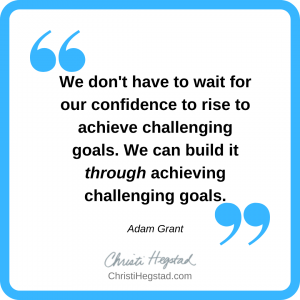
Just like success itself, confidence is built one small win at a time.

Quote Box - Grant - Challenging Goals

We are nearing the end of the first week of 2021’s final quarter. Take a moment to ask yourself what you’d LOVE to celebrate at the end of the year.

Then break it into small, manageable pieces, and take it one small, confident step at a time.

At the end of the year, you can celebrate your achievements *and* your strengthened confidence!

What’s one work or life area you are focusing on this quarter? Share below or on Instagram – I’d love to cheer you on!

Christi Hegstad, PhD, PCC, is the Practical + Purposeful Coach for Achievers!  Join our email community for coaching tips, book recommendations, tools, resources, and more!

What’s On Your “Won’t Do” List?

Christi Hegstad October 6th, 2021

When I shared my top ten lessons learned in September, #1 said:

A ‘won’t do’ list can be just as valuable as a ‘to do’ list. 

This lesson garnered more feedback (particularly on LinkedIn) than any other.

A ‘won’t do’ list is just as it sounds: A list of things you will not do.

I also think of it as a sort of ‘best practices’ for my boundaries.

Your ‘Won’t Do’ List

So, how do we create our Won’t Do lists? I suggest the following three steps:

First, envision when you feel your best. What contributes to that experience? What is generally in place? How, specifically, does it feel? Start by placing yourself in your ideal.

Next, consider times when you feel drained, depleted, or ‘off.’ What contributes to those experiences? Are certain traits nearly always in place?

Finally, look at your two lists, and start identifying what you need to stop doing or tolerating in order to experience more high-quality moments.

This will form the beginning of your Won’t Do list.

Examples

Your Won’t Do list will be unique to you. But to get some ideas flowing, consider the following examples:

I won’t engage in arguments with strangers on the internet.

I won’t take Aunt Enid’s questions about my home-buying decisions personally. 

I won’t check email after 7pm.

I won’t start work for the client until all the paperwork is signed.

I won’t say Yes to requests for my time until I’ve given myself an hour to consider them.

You can think in terms of relationships, work, home care, personal life, and beyond. If your list grows long, consider prioritizing so you can pay attention to the top handful of ideas.

Don’t Forget The Final Step!

Now that you’ve created your Won’t Do list, remember the all-important final step:

Honor it!

When faced with an opportunity, challenge, or uncertainty, ask yourself your usual questions, such as:

Does it align with my values and purpose?

Will it move me closer to my vision?

How does it feel?

If you still need further clarification, or if it doesn’t yet feel 100% right, refer to your Won’t Do list.

Let this additional layer support your meaningful, purposeful decision-making!


Christi Hegstad, PhD, PCC, is the Practical + Purposeful Coach for Achievers!  Join our email community for coaching tips, book recommendations, tools, resources, and more!


Monthly Review – September Lessons Learned

Christi Hegstad October 3rd, 2021

Another month, another bunch of lessons it brought me! Can you relate to any of these?

1. A ‘won’t do’ list can be just as valuable as a ‘to do’ list. #boundaries

2. Finish the half-finished stuff. You’ll feel better!

3. Five minutes of action is better than any minutes of worrying.

4. Take the nap.

5. Discovering pockets in your new dress = instant awesomeness!

6. Make the decision. Then take an action in favor of it.

7. When overwhelmed, S I M P L I F Y. Return to the basics.

8. Sometimes ’80s country music is exactly what’s needed!

9. Take yourself on a little adventure, just because.

10. If it’s worthwhile, give it your all. It might not be easy, but you’ll never regret doing the best you can.

Let me know if one of these resonates with you, too!

Christi Hegstad, PhD, PCC, is the Practical + Purposeful Coach for Achievers!  Join our email community for coaching tips, book recommendations, tools, resources, and more!

Who’s Deciding Your Priorities?

Christi Hegstad August 9th, 2021
If we don’t decide what is most important to us, the world will decide for us. – Molly Fletcher
Have you noticed it’s easier to say ‘no’ to something if you’ve already made a commitment for that same time?
That’s similar to what clear priorities do for us.
If we know the handful of things that matter most at this time, we can more easily say no to other lower-priority items.
This week, discern your current top priorities.
I intentionally use the word ‘current’ here, too. Priorities can and do change over time.
Look at the season of the year you’re in – as well as the season of life.
Decide what your top priorities are – your definite YES items. Write them on a notecard and keep it handy.
See if this helps you make decisions – with your time, energy, and resources – in favor of what matters most to you.
Christi Hegstad, PhD, PCC, is the Practical + Purposeful Coach for Achievers!  Join our email community for weekly coaching tips, free resources, book recommendations, and more!

Think Again: Book Review + Takeaways

Christi Hegstad August 4th, 2021

This blog has taken me ages to write – not because I don’t know what to say, but because I basically want to share every word from Think Again with you! I mean, I actually ran out of page flags while reading and annotating:

Think Again book page flags

I’ve enjoyed Grant’s earlier work, but I am blown away by how much value I have gained from Think Again. I am applying its lessons everywhere and continuing to delve deeper into the topics he presents. This book will definitely stick with me long-term!

Overview

Essentially, Think Again encourages us to practice the skill of unlearning, rethinking, and challenging ourselves to not believe every thought we have. Grant states:

Every time we encounter new information, we have a choice. We can attach our opinions to our identities and stand our ground in the stubbornness of preaching and prosecuting. Or we can operate more like scientists, defining ourselves as people committed to the pursuit of truth – even if it means proving our own view wrong. (p76)

Grant’s writing is engaging, thought-provoking, and filled with both quantitative and anecdotal evidence to support his arguments. He shares examples from sports, healthcare, academia, social justice efforts, and more; I have looked up further details on many of the individuals he highlights as they remind us how one person has the power to make a HUGE impact!

Think Again truly feels like a book with something for everyone.

Top Takeaways

As I mentioned, narrowing down my top lessons has proven challenging – I feel like I’ve highlighted about every other sentence! But to get us started, a few standout themes:

1. Detachment requires conscious effort. (And it’s worth it.) 

Detachment – what I would summarize as the art of letting go – does not necessarily come easily or naturally to us. We confuse our thoughts with absolute fact, we connect our identity to our opinions, we worry about what others will think if we change our stance or go against the grain.

And we definitely don’t want to feel – or appear – that we’ve been wrong about something our entire lives.

Being able to open ourselves to new thoughts, however, can actually help us become mentally healthier. We can detach our present self from our past self, viewing it as growth instead of placing judgment on how foolish we once were. “It’s a sign of wisdom to avoid believing every thought that enters your mind,” Grant offers. “It’s a mark of emotional intelligence to avoid internalizing every feeling that enters your heart.”

Changing your beliefs over time doesn’t always mean you were wrong or that you’re wishy-washy. It simply means you’ve gained more information, experience, or insight – and have evolved your thinking as a result.

2. We can’t necessarily change other people – but we may be able to help them open their minds.

Grant talks about common tendencies when it comes to our beliefs: We may focus our energy on preaching about all the reasons we’re right, for example, and/or expend our effort telling others all the ways they are wrong.

These strategies, however, can have the opposite effect than we hope: “When we’re trying to persuade people,” writes Grant, “we frequently take an adversarial approach. Instead of opening their minds, we effectively shut them down or rile them up.”

A more effective approach involves enlisting the qualities that scientists tend to adopt: curiosity, humility, collaboration, listening, a willingness to be proven wrong. The examples he offers in Think Again, such as a Black musician who has used the art of conversation to help white supremacists let go of their hatred, are utterly profound.

3. ‘Confident humility’ allows us to honor how far we’ve come while acknowledging how much we’ve yet to learn.

The phrase ‘confident humility’ essentially means believing in yourself while also recognizing you still have more to learn. This blend of security plus room for growth allows us to develop as stronger leaders, achievers, and true difference-makers.

Grant frames this concept using examples of the armchair quarterback and the impostor: When we think we already know everything, as in the case of the armchair quarterback, we leave no room for new ideas or information. Yet when we don’t give ourselves credit for what we do know, like the impostor, we undervalue our worth and hold ourselves back from our full potential. (An interesting side note: Grant points out that what we commonly refer to as impostor syndrome “seems to be particularly pronounced among high achievers.”)

Confident humility, as both a phrase and a concept, has resonated deeply with me and with many of my coaching clients as well. We can believe in ourselves while acknowledging we still have more to learn; we can honor our strengths while still recognizing – but not being taken down by – the fact that we also have weaknesses.

I wrote a few more thoughts about confident humility here.

I’ve written other takeaways here – oh, and here, too. (I’m telling you, I can’t get enough!)

Closing Thoughts

It’s rare to come across a book I feel is applicable to just about anyone, but Think Again is such a book. I’d especially recommend it to leaders, educators, and those who often find themselves in negotiation conversations (ie, sales professionals, mediators, change-makers). In addition, this would be a valuable resource for anyone in the business of helping others improve their quality of life – physicians, counselors, healers, and the like – particularly the sections on motivational interviewing.

But in all honesty, Think Again could improve conversations in nearly any household or relationship, as well as in the overall realm of personal growth. His points around meaning, psychological safety, arguing effectively … I could go on and on.

I’ve read over 60 books so far this year, and Think Again is an absolute standout among them. Pick it up, devour its wisdom, and let me know your takeaways!

Christi Hegstad, PhD, PCC, is the Practical + Purposeful Coach for Achievers!  Join our email community for weekly coaching tips, free resources, book recommendations, and more!

* Think Again was written by Adam Grant and published by Viking, an imprint of Penguin Random House LLC. Copyright © 2021.


3 Confidence Boosters You Can Implement TODAY

Christi Hegstad August 2nd, 2021

Even the most high-achieving among us can have issues with confidence.

If you feel yours faltering from time to time – or even regularly – you don’t need to wait, wish, and hope for things to turn around.

Here are three confidence boosters you can implement immediately:

1. Document a daily win.

Once a day, for three weeks, jot down a win you experienced that day. Maybe you spoke up in a meeting, pushed ‘publish’ on your blog, or hired your first coach. Make note in a journal or on your phone.

After three weeks, you’ll have quite a collection of wins to review when you need a boost! Read this for more ideas on what I call a Success Journal.

2. Stand, sit, and walk tall.

When someone starts talking about the importance of posture, do you immediately straighten your shoulders and sit up taller? Practice this on a regular basis, maybe even putting periodic reminders in your phone.

Amy Cuddy has some intriguing research around this topic – check out her TED Talk for more.

3. Honor a commitment you make *to yourself.*

If you commit to walking for 15 minutes, or making a particular phone call, or waking up by 7am, do it. This builds self-integrity while also providing a sense of achievement.

Note I said *a commitment* – as in singular. Don’t list 18 or 12 or even 4 things you’ll do; pick one, a simple one, and follow through. You can always build from there.

Which one of these confidence boosters will you implement? Which one might help your colleague, team member, or child? What tip would you add to this list?

Christi Hegstad, PhD, PCC, is the Practical + Purposeful Coach for Achievers!  Join our email community for weekly coaching tips, free resources, book recommendations, and more!

Learn Something From Everyone

Christi Hegstad August 2nd, 2021
Great thinkers don’t boast about how much they know; they marvel at how little they understand… A mark of lifelong learners is recognizing they can learn something from everyone they meet. – Adam Grant
Do you believe you can learn something from everyone?
What if you approached this week committed to doing so?
You might learn a new perspective.
You might learn a way of communicating that makes everyone feel included.
You might learn how not to behave.
Whatever it is, take note. Never stop learning!
Christi Hegstad, PhD, PCC, is the Practical + Purposeful Coach for Achievers!  Join our email community for weekly coaching tips, free resources, book recommendations, and more!

Monthly Review – July Lessons Learned

Christi Hegstad August 1st, 2021

Time for my monthly roundup of lessons learned or relearned. Here are some of the key lessons July brought my way:

1. Some days I wonder if any of us truly feels like a full-fledged adult! 😀 (This one stemmed from a lot of really funny conversations this month!)

2. Asking myself ‘What’s the lesson here?’ is one of the best habits I’ve ever developed.

3. You attract what you track.

4. Sometimes (often?) the journey far surpasses the destination.

5. Investing in your personal growth is hugely worthwhile.

6. I believe I could easily eat Mediterranean food every single day.

7. Time flies.

8. Time especially flies with kiddos! I savor the moments with them.

9. My favorite days include a healthy blend of productivity + peacefulness.

10. Is there anything better than watching someone light up as they share what they’re passionate about?!

What food could you eat daily and never tire of? What is one of the best habits you’ve developed? What do your favorite days include?

Share a lesson below or on Facebook – or let me know if any of mine resonated with you!

Christi Hegstad, PhD, PCC, is the Practical + Purposeful Coach for Achievers!  Join our email community for weekly coaching tips, free resources, book recommendations, and more!

Finding Purpose In The Doing Rather Than The Result

Christi Hegstad July 27th, 2021

If I told you the artwork you see here was painted by a 9-year-old, what would you think?

What if I told you it was painted by a 49-year-old?

Many of my recent conversations (and thus posts) have focused on perfectionism. It seems many achievers equate success with perfect – or at least exceptional – performance. Anything less can make us feel like less.

This painting was done just the other day, by me, in my personal journal. My watercolor skills have not improved probably since age 9.

But you know what?

When I look at this painting, I feel proud.

Not because I think it’s an outstanding work of art.

And certainly not because I see massive improvement in my skill over the years. (In fact, my watercolor skills may have even declined!)

But I feel proud because the purpose of playing with watercolors is, for me, 100% personal. The feel of the brush sliding across the paper soothes my nerves. The jovial colors that appear as I flip through my journal brighten my mood. The fact that I don’t judge or criticize myself at all for the outcome, imperfect as it is, feels liberating.

We don’t have to do all things perfectly in order for them to have purpose.

Don’t get me wrong: I still have many areas where I want to excel and improve. Growth is one of my core values, and also highly important in our quality of life.

But sometimes, the purpose can be found in the mere act of the doing – not because of the end result.

Do you agree? What do you do merely for the joy, or emotion, or delight it brings you in doing it?

Christi Hegstad, PhD, PCC, is the Practical + Purposeful Coach for Achievers!  Join our email community for weekly coaching tips, free resources, book recommendations, and more!

My 7 Favorite Mid-Summer Motivators!

Christi Hegstad July 21st, 2021

Maybe it’s a post-vacation lull.

The heat.

The fact that everyone seems to be out of the office.

Or maybe it’s for no reason whatsoever – but you’re feeling a massive lack of get-up-and-go these days.

If this doesn’t sound like you, skip this article and leave your best tips below!

But if it does and you’re craving a bit of a boost, here are 7 of my favorite mid-summer motivators:

1. Connect with inspiring people.

Schedule a meeting with your mastermind group, set up a session with your coach, or call a colleague who’s always doing something cool.

2. Return to something you used to love.

Crossword puzzles in the evening? Crafting macrame plant holders? Reading a book you loved as a child? Revisit something that previously lit you up.

3. Try something new.

On the flip side, try something brand-new – and give yourself permission to do it poorly, too. Release any expectations and just have fun experimenting.

4. Disconnect.

Hide your phone and laptop for a length of time that feels challenging to you. Repeat every few days.

5. Immerse yourself in study.

This may sound counterintuitive, but deepening your learning in something you’re passionate about can serve as a great energizer.

6. Take a break.

If a week off isn’t in the cards, try a morning off and head to your favorite walking trail, or spend an afternoon at your local botanical gardens.

7. Remember your ‘why.’

I’ve said it a million times, but remembering why you started – reconnecting with your purpose – is the greatest motivator I know!

And in case anyone needs the reminder, we aren’t designed to be motivated and productive 24/7. A temporary lack of motivation can be a good cue to simply relax for a while! But if you’re looking for a boost, I sincerely hope one of these ideas speaks to you.

Which one will you try, or what idea does it prompt for you? Share on LinkedInInstagram, or Facebook!!

Christi Hegstad, PhD, PCC, is the Practical + Purposeful Coach for Achievers!  Join our email community for weekly coaching tips, free resources, book recommendations, and more!

Website Design by Happy Medium