Category Archives: Uncategorized

3 Tools For Making Purposeful Decisions

Christi Hegstad October 4th, 2017

Many of you have asked about the details around the decision to make this upcoming Spark event the final one. After years of sold-out audiences, hundreds of testimonials on Spark‘s work- and life-changing impacts, and nationwide recognition, how have I made the decision to make this the final Spark?

I’ll start by saying this decision did not come lightly. But once made, it was with 100% certainty – a knowingness, if you will. And, as will often happen with centered, purposeful decisions, everything transpiring since then – including some exciting new openings this decision has created space for – has served as confirmation.

So how did I make this decision? And how can you make decisions with confidence and knowingness? Here are three strategies I have found invaluable:

Consult My Purpose Statement.

First and foremost, my Purpose Statement serves as my filter for decisions. Since it incorporates my values (among other things), I know that basing decisions on how they align with my Purpose Statement will always serve me well. (If you’re coming to Spark, you’ll leave with YOUR Purpose Statement too, as well as a personalized plan to put it into action.)

I’ve often struggled with trusting my intuition and have just recently discovered why, another lesson I will share at Spark. While I’ve gotten much better over the years, and my Purpose Statement provides a type of constancy that I can rely on in any situation. I appreciate having something ‘outside my own head’ to guide me! 😉

Talk With My Advisors.

Although I’ve been a certified coach for years I still, and likely always will, have a coach myself. I’m also part of Mastermind groups that have proven invaluable.

These individuals, along with my family, close friends, and a few other ‘key players,’ serve as such a trusted source of wisdom for me. Whether my decision relates to my business, personal life, health, vacation ideas, or anything in between, these are the people to whom I turn. While thinking through things is important, verbalizing them usually brings about a different kind of clarity.

Practice 10-10-10.

The book by this same name, written by Suzy Welch, has been a game-changer for me and many of my clients when it comes to sound decision-making. Essentially, the process encourages you to make a hypothetical decision, then examine the possible consequences 10 minutes, 10 months, and 10 years from now. I have used this strategy repeatedly over the years and am grateful for perspective it offers! You can find a nice summary of the book here.


I used to struggle tremendously with decision-making, spending waaaay too much time overthinking, ruminating, second-guessing. Years ago I made a change: I decided one of my Guiding Principles would be

Decide And Take Action.

Meaning, once I make a decision, I immediately take an action in favor of it. This principle alone has transformed my decision-making and reduced my “buyer’s remorse” by leaps and bounds! Maybe something to incorporate into your practice, too?

These three steps essentially make up how I made the decision. I will explain the reasons why the public Spark will not continue after this year, some of which are quite personal, at the event itself. We are almost out of spots so if you’d like to join us, click here . I can’t wait for our purposeful, positive day of growth together!


Becoming A Master Of Your Craft

Christi Hegstad October 3rd, 2017
“Be so good they can’t ignore you.” 
Steve Martin
 
Coaching Tip of the Week:
We live in a world often looking for the fast solution, the instant gratification, the get-rich-quick answer.
When asked what advice he would give people wishing to mimic his success, actor/comedian Steve Martin lamented that no one listens to his advice because it’s not what they want to hear.
“What they want to hear is ‘Here’s how you get an agent, here’s how you write a script,'” Martin replied to Charlie Rose, “but I always say, ‘Be so good they can’t ignore you.'”
This week, begin mastering your craft
While you can’t necessarily control everything about your work or workday, you can control your effort, attitude, and approach. Always.
Ask yourself what would up-level your skills even more. Reading daily in your field? Hiring a coach? Taking a class? Attending a professional development event like Spark?
Take one step toward mastery this week. Start being so good that we can’t help but take notice!
To read my takeaways from the book, So Good They Can’t Ignore You, click here to visit my blog. And to join us for Spark, click here!

Things You Can Do When You Don’t Know What To Do

Christi Hegstad October 2nd, 2017

When you hear difficult news or experience the unfathomable, how do you tend to respond?

Like most people, I’m continually trying to navigate this. I imagine it will be a lifelong experiment. One thing I have learned about myself, however, is that I am much more effective – and feel much better – when I take purposeful action.

But sometimes the question is, what action can I take? What could possibly make a difference?

This morning, I asked myself these questions once again – then generated this brief list. What would you add?

1. First and foremost, feel your feelings. If tears need to flow, pillows need to be screamed into, hugs need to be requested – give yourself permission to feel what you feel. You can still be a positive, purposeful person and experience the wide range of human emotions available to us.

2. Shift your questions. While there is a time and place for asking ‘why’ and getting to root causes (for growth, not blame), we must also remember that the quality and focus of our answers depend on the quality and focus of our questions. When you feel stuck, switching to ‘how’ questions can often open you up to possibility: How can I improve the situation? How can I help? How can I take one step forward?

3. Conduct a person-to-person act of kindness. Send an unexpected gift card to a teacher. Write a heartfelt letter of gratitude to a service provider. Leave a pre-paid gas card and a “You’re amazing!” note to someone who recently lost his job and may not feel so amazing. Make eye contact when speaking.

4. Connect with your core values. There’s a line in an old country song that goes, “You’ve got to stand for something or you’ll fall for anything.” Know what you stand for. Also, recognize that you can’t stand for everything and still be effective.

5. Support values-aligned causes. Which do you see as more beneficial: Giving $20 to 100 different organizations, or giving $2,000 to one that supports what you believe in most? Once you clarify your values, consider donating focused time and treasure there.

6. Share your personal strengths. You’re a great writer? Consider contributing to a nonprofit’s newsletter. Amazing eye for interior design? Offer to create a welcoming lobby for a facility that helps people in need. Gain joy from using your strengths while you make a difference for others.

7. Note what’s within your control. This is difficult – and especially important – in situations where we feel like we have no control. We always have control over something, such as our attitude, how we respond to a situation, the words we speak, the actions we take, the way we carry ourselves. We may also have the ability to help, provide a safe space or listening ear, donate blood, or offer a service. Create a Breakthrough Map of possible actions, perhaps teaming up with a friend or group to get even more ideas flowing.

8. Take care of yourself. Breathe, nourish, move, create…fuel yourself. Consider your spiritual and emotional needs as well, inviting prayer, meditation, affirmations, or inspirational text into your life. Like the oxygen-mask-on-an-airplane metaphor, you must first take care of yourself if you want to be able to take care of others.

9. Seek professional help. Whether a therapist, physician, healer, coach, spiritual director…the options are endless. You don’t have to go it alone.

10. Refrain from social media. This may mean reading, as it can become overwhelming in the face of a national or global issue. It may also mean posting, unless you’re going to contribute to the conversation in a meaningful and helpful manner.

11. Pour extra love into the world. Love your family, friends, coworkers, cashiers, fellow drivers on the highway, grumpy service providers… everyone. Model what it’s like to love love love.

12. And in the words of Mr. Rogers’ mom, look for the helpers. They’re always there, and they will always remind you of the truest shining goodness of the human spirit.

Many of these may just serve as starting points or seem like they wouldn’t change the world. But sometimes what we need is the starting point, to provide us with the energy, momentum, and resolve to then dig deeper and do the big work. As Mother Teresa said, “Help one person at a time, and always start with the person nearest you.”

What actions help you when you don’t know what to do? I welcome your additions to this list. Perhaps together, we can create a working document that we can turn to whenever we wonder what we can do to lift ourselves, our families and friends, and humanity to a higher level.

Much love to you, friends.

How To Create A Breakthrough Map In 5 Steps

Christi Hegstad October 1st, 2017

When I was in graduate school, the topic of the doctoral dissertation would inevitably come up in class from time to time. From the moment we received our acceptance letters into the program, we knew conducting a massive research project and writing a massive, extremely rigorous, paper about it would be part of our requirement.

But we were also good at thinking, “Eh, I don’t have to worry about it yet.”

Until, of course, we did.

The dissertation posed a challenge unlike any I had pursued up to that point. I had set and achieved big goals before, and I had stretched myself beyond my comfort zone many, many times. But the pre-research, the planning, the formulating of questions, the meta-review of data, the interviews, the structure requirements… Where to even begin? It didn’t surprise me so many students finish with their ABD – All But Dissertation – instead of the Ph.D., but I was determined to complete what I’d started because it meant so much to me.

It was then that I experimented with what is now one of my favorite tools for turning big wild dreams into reality. I’ve used it practically weekly ever since.

The Tool For Breakthroughs

The first step to success is, of course, determining what you want to accomplish, and I shared two questions to help you clarify that in my Breakthrough Goal article a few days ago.

I also promised in that article to share one of the best tools I know for propelling yourself down the path of accomplishment, which is the focus of this article. Once you’ve determined what you want to accomplish – writing a book, tripling your business revenue, hosting the greatest event ever, completing your dissertation, or practically anything else, your next step to set it in motion: Create a Breakthrough Map!

A Breakthrough Map (also referred to as a mindmap or idea web) serves multiple purposes: It allows you to get thoughts out of your head and onto paper (instant relief), gives a visual display to see gaps and prompt further ideas, and provides the starting point for an action plan. These maps can also prompt more, richer, and higher-quality results than standard lists.

In essence, Breakthrough Maps make the impossible possible.

How To Create A Breakthrough Map In 5 Steps

Like with most professional development tools, there is no single way to create a Breakthrough Map, but perhaps these steps I’ve learned over the years since my grad school days can help:

1. Decide Your Topic/Goal.

By now you hopefully have your Breakthrough Goal identified, but if not – or if you need help refining it – revisit my earlier article. Try to be as specific as you can. For example, a desired outcome of raising $100,000 for your nonprofit will yield better possible actions than “make more money.”

2. Phrase It In “How Can I…” Format.

Rather than simply putting your goal on paper, turn it into a “How can I…” question. You might consider this simplistic, but it shifts your mind into problem-solving mode and actually unlocks more than the goal statement by itself. It also assumes positive success: There’s no questioning whether you can succeed, the question is merely how – what steps your success might require.
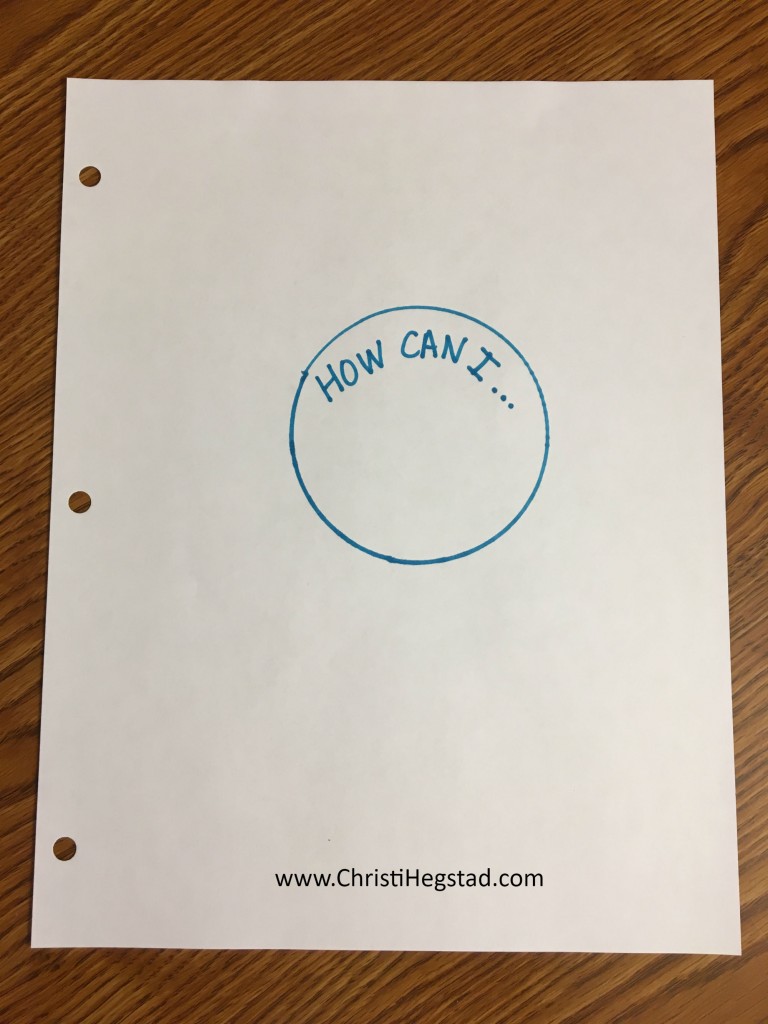
Breakthrough Map - How Can I

On a blank piece of paper (consider large poster paper your friend here!) or a whiteboard, draw a circle in the center and write your How Can I question inside of it. For example, my Spark live event is just around the corner and since it’s my final one, I am putting my all into it. One of my earliest Breakthrough Maps posed the question, “How Can We Make Spark ’17 The GREATEST EVENT EVER?” My team and I have had SO much fun dreaming on paper with this!

A topic several clients have brought up, especially as we move into 4th quarter, revolves around their goals and ongoing distractions: “How can I stay focused on my top-priority goals as we near the end of the year?” I’ll use a version of this as an example as we continue:
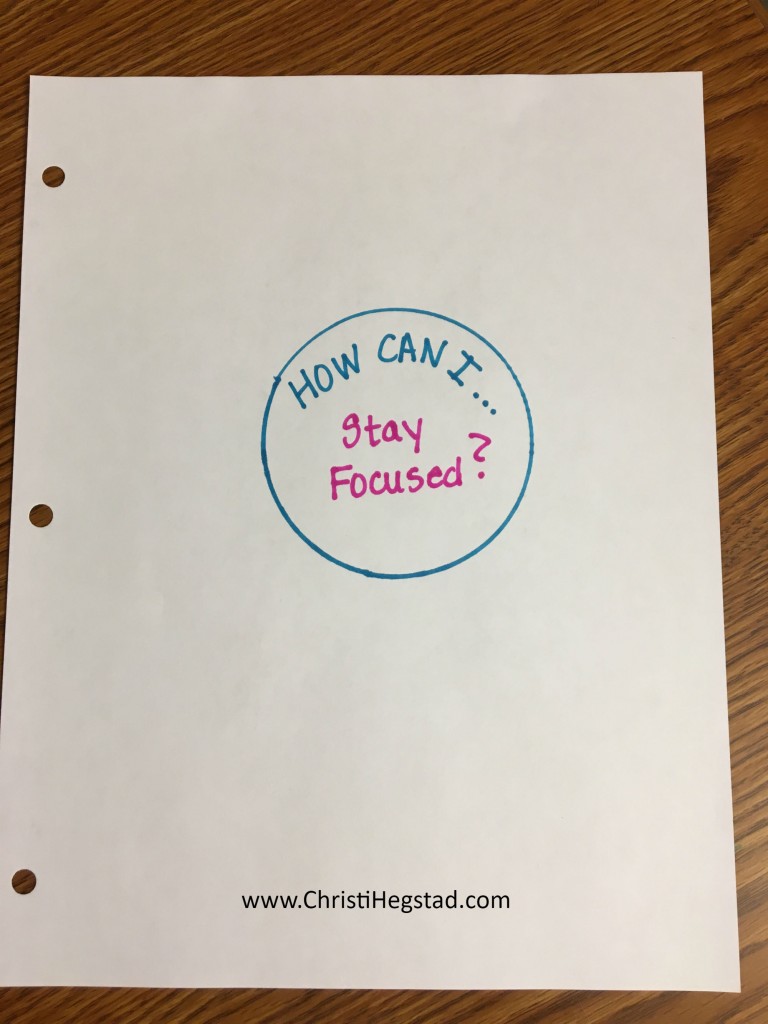
Breakthrough Map - Starting Question

 3. Empty Your Mind Onto The Map.

Now it’s time to free up your mind space by purging all your thoughts, ideas, and even random possibilities onto the paper. Make a big mess. Pour them out in any order. Include actions to take, people who could help, resources you might call on, books that may support you, tools you may need…anything and everything that comes to mind.

This step will challenge the list-makers out there (I’m right there with you!) but believe me, it’s a challenge worth accepting! Don’t try to order your thoughts at this point. I promise there will be time for that later. 🙂
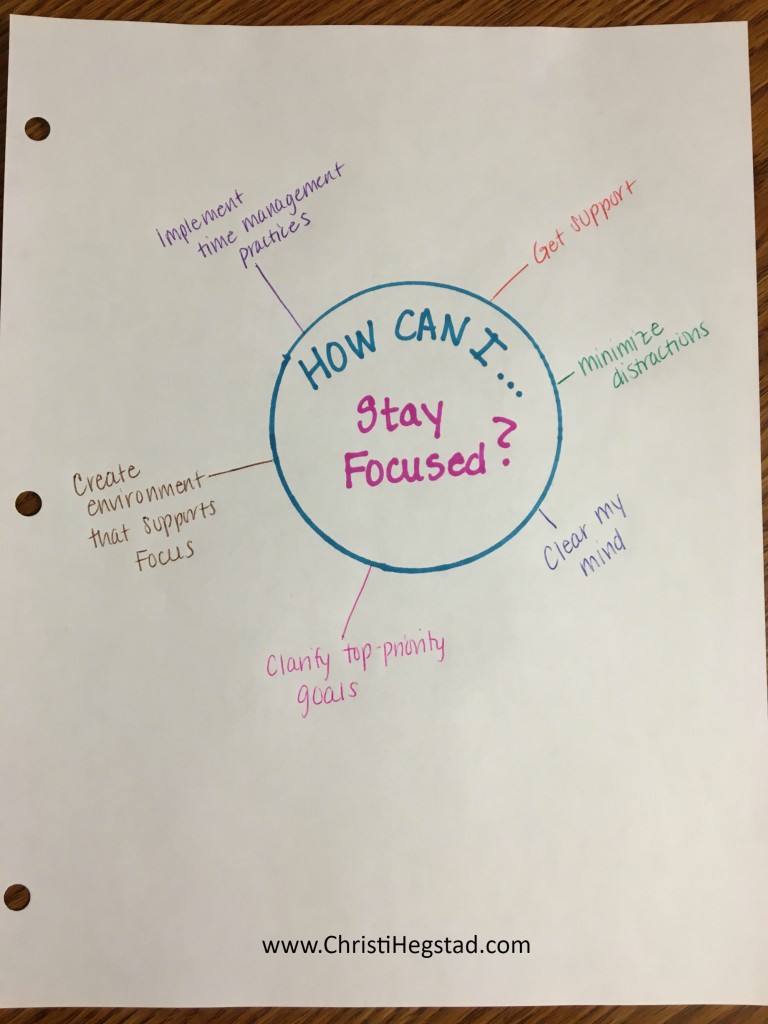
Breakthrough Map - Getting There

When I work with my coaching clients on Breakthrough Maps, I encourage them to keep going until they’ve generated at least 25 ideas. This can seem daunting at first, but it stretches your mind and helps you think beyond the status quo. Depending on your topic and where you are in your process, you might invite trusted others (i.e., your mastermind partners) to contribute possible actions as well.

Remember: You are not creating a to-do list here. You are simply giving space to ideas. You may decide later to only implement 1/3 of them – it doesn’t matter. The goal is to stretch, expand, and generate possibilities.

4. Leave It Alone.

Once you’ve created at least 25 ideas, step away from your Breakthrough Map for a while. Go for a walk, take a nap, do some yoga, switch to another project, maybe even put your map in a drawer for a day or two. As additional ideas come to mind, add them to your map.

5. Start Categorizing.

You can do this in a few different ways. One possibility: Take your ideas from your first Breakthrough Map and create a second one with logical categories.
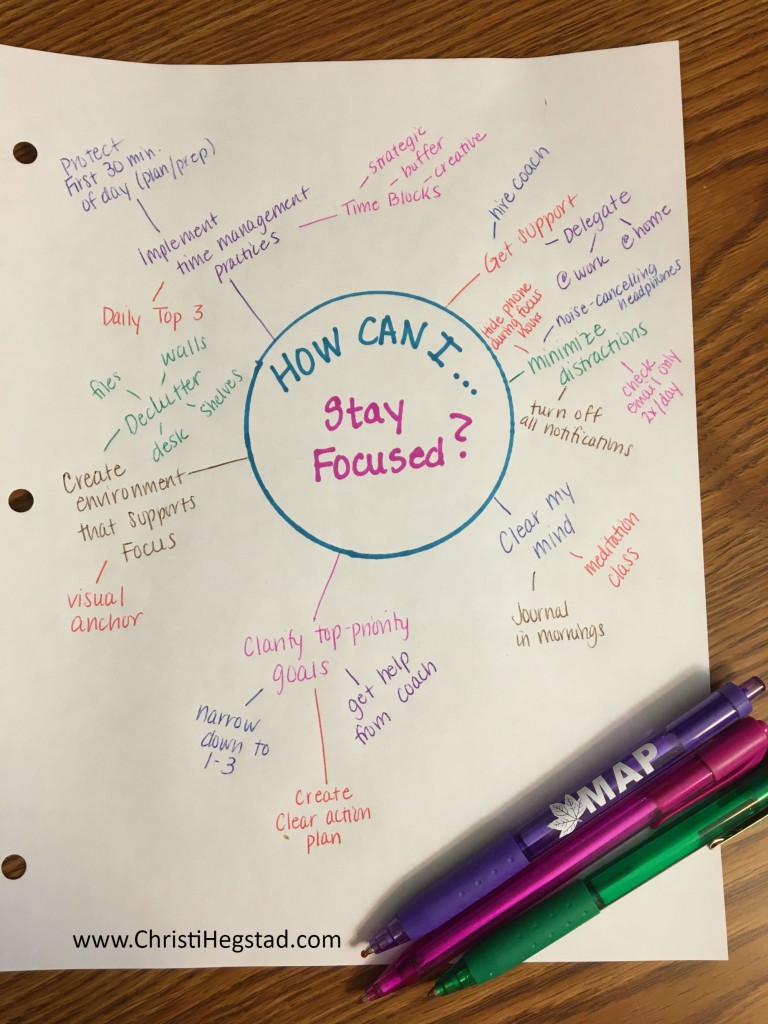
Breakthrough Map - Complete

What I’ll often do instead is take different colored highlighters and mark categories accordingly. With the Spark example I gave earlier, I poured everything out onto the map, then used pink highlighters to note any actions related to the venue/environment, blue for logistics, yellow for materials, green for guest speakers, and so on.

Or, if your list-making itch has gotten the best of you, you can now start forming your thoughts into lists.

From Idea Into Action

While you can use your Breakthrough Map itself as your action plan, checking items off as you go, I’d suggest turning your “beautiful mess” into a truly organized action plan; my free Big Dreams, Bold Goals e-book can help you with that (click here to get yours).

What do you think? Ready to create a Breakthrough Map?

No joke, I make one at least weekly – and usually more often. I’ve created Breakthrough Maps for everything from the book that I’m writing to summer activity ideas to how to solve a problem that’s keeping me stuck to anything on which I find myself procrastinating. My journal is full of these random scribblings and I am so much better for it!

So whether you need to get unstuck, determine your first (or next) step in a project, or brainstorm what to pack on your upcoming trip, give the Breakthrough Map strategy a try. Let me know how it goes by sharing below, or on Instagram or Facebook! And for more on Breakthrough Maps and so many other practical, useful, research-based tools to help you fulfill your highest potential, join me at Spark on November 3 – click here for details!




Morning Journaling For Peace, Purpose, and Positivity

Christi Hegstad September 30th, 2017

Doesn’t the space in this photo look like a peaceful setting for morning journaling? I was happy to take advantage of it this week. There’s nothing quite like beautiful scenery and a gurgling river to help the ideas flow!

So many different ways to journal exist: stream-of-consciousness writing, gratitudes, daily recaps, morning pages, lists…to name just a few. I find journaling so helpful for getting thoughts out of my head and onto paper, thus freeing up mental space (and who couldn’t use more of that?!). I also brainstorm ideas, dream, process through challenges, vent, plan, and so much more via my journal!

Do you keep a journal? How do you like to use it? Share your thoughts below or on Instagram or Facebook! And to gain a variety of journal prompts and topics, be sure to join us for Spark on November 3!

The Secrets To Being So Good They Can’t Ignore You

Christi Hegstad September 29th, 2017

Two reasons in particular drew me to Cal Newport’s book, So Good They Can’t Ignore You:

1. His more recent book, Deep Work, was one of my 3 favorite books read in 2016. (FYI, I read a lot of books.) I had the privilege of hearing Newport speak at a coaching conference that spring and was impressed with his knowledge, ethic, and sense of story.

2. I knew the title of this book came from a line by Steve Martin, one of my all-time favorite actors (not to mention, banjo players). I figured any book inspired by the incomparable Martin had to be pretty amazing!

I was not disappointed.

I was, however, challenged, and in a way that I have been challenged for the past 18 months. I’ll get back to that in a moment.

The Overarching Premise

Newport makes his thesis clear before his book even hits page 1. “The conventional wisdom – follow your passion – is seriously flawed,” he writes in the introduction. “It not only fails to describe how most people actually end up with compelling careers,” he goes on to say, “but for many people it can actually make things worse: leading to chronic job shifting and unrelenting angst when…one’s reality inevitably falls short of the dream.”

What? Aren’t we supposed to do what we love?

Not according to Newport. But fortunately he doesn’t just tell us what not to do; he offers an alternate plan of action, too. A couple of his suggestions:

Be so good they can’t ignore you. In an interview, Charlie Rose asked Steve Martin his advice for aspiring performers, to which Martin replied:

What they want to hear is ‘Here’s how you get an agent, here’s how you write a script’…but I always say, ‘Be so good they can’t ignore you.’

And how might we go about doing that?

Develop your skills to mastery level. Shift your mindset to one of a skilled craftsperson. Don’t just practice, but engage in deliberate practice – the type of practice that stretches your skills and requires focus, concentration, and intentional effort.

That last part is significant: Many of us mostly practice what we already know because competence feels nice. From psychologists like Anders Ericsson, however, we’ve learned that mere practice isn’t enough to reach a level of mastery. We must practice deliberately, challenging ourselves and continuously stretching beyond what we know, which is often unpleasant and unenjoyable but massively skill-building.

Establish a sense of control. Autonomy goes a long way toward professional development and career joy. “Giving people more control over what they do and how they do it,” writes Newport based on his research, “increases their happiness, engagement, and sense of fulfillment.”

If you’re an employee, ask yourself where you have control in your profession. (Side note: “Nowhere” is an unacceptable answer. If nothing else, you always have control over your attitude, effort, and personal growth.)

“Think Small, Act Big.” This still has me spinning a bit. Perhaps since some of my frequently-used hashtags on Instagram and Twitter are #dreambig #startsmall!

But the story Newport offers in this section, about a Harvard biology professor named Pardis Sabeti, is perhaps my favorite in the entire book. She is an incredible example of someone who connects her work to a greater purpose, and she is changing lives – and the world – as a result. “Her happiness comes from the fact that she built her career on a clear and compelling mission,” writes Newport, “something that not only gives meaning to her work but provides the energy needed to embrace life beyond the lab.” She is a biologist, teacher, guitar player, volleyball player, and more. Her mission brings purpose to her days and energy to her life in a way no supplement could, and it allows her to work with enthusiasm and joy in a very demanding, often high-stakes position.

Accepting The Challenge

Newport, as well as my own research and book writing in the past 18 months, has challenged one of the foundations on which I built my business nearly 15 years ago – something I’ll share more about at Spark. His theories are valid, based in sound research, and explored through wonderful stories of musicians, athletes, business leaders, farmers, and everyone in between. So Good was both enlightening and entertaining to read.

So how might you apply some of these learnings to your own work and life? My favorite part of the book (aside from the stories, like Pardis Sabeti) is, interestingly, the conclusion: Here, Newport takes what he learned through his research and applies it to his own experience. While still a work in progress – as we all are – making shifts in his daily actions, focus, and mindset have impacted his life experience in very insightful ways.

Now it’s your turn: How can you bring more meaning and growth into your own work experience? How might you become so good they can’t ignore you? Share your ideas below or on Facebook, Instagram, and Twitter! And to create a full action plan around your core values and meaningful work, be sure to join us for Spark – limited seats left!

Bringing INTENTION To Work and Life

Christi Hegstad September 28th, 2017

“Have you ever driven home from work,” a client asked, “and realized that you have absolutely no recollection of the drive? Like you’ve done it so many times, your car just goes where it needs to go, and it’s all a blur to you?

“That’s how I feel like I’m living my life. On complete autopilot.”

Can you relate?

I’m willing to bet many of us can, on some level. We live in a go-go-go time, often running on autopilot – and on empty – all at once.

But it’s just the time we live in, right? What can we do about it?

Well, it turns out, a lot.

I’ve long said that time management ultimately comes down to two key factors: priorities and intention. In other words, deciding what deserves your highest attention, then consciously choosing to place your attention there.

Living and working with intention doesn’t require a complete overhaul, either. Start with your morning: What’s one thing you could do upon waking that would focus on what matters most rather than “what’s always there”? Forego the email and social media first thing in the morning in favor of a quiet word of gratitude, a bit of stretching, some journaling. You’ll start your day with intention, setting the tone for the rest of the day.

Consider actually setting an intention for the day, too: A word or phrase that captures who and how you want to be in the world that day. Calm? Focused? Energized? Positive? Intentional? Scan your day’s activities and choose a word that speaks to what’s ahead. You can call your intention word to mind all throughout the day for a quick pattern-break and reminder to focus on your intention.

Experiment with your senses, too. Earlier this year I read the book Mindfulness by Williams and Penman, and I will never forget their simple-but-poignant exercises – like slowly eating a small piece of dark chocolate, paying attention to the sound of the wrapper, the shape of the chocolate, the texture, the scent, the feel as it melts in your mouth. When you practice mindfulness in small activities like this, you start to embrace how you can move with greater intention through other areas of your life as well.

Take note of what distracts you most, too. Your phone? TV? Social media? A less-than-helpful habit? You can just as easily begin your intentional practice by removing a distraction rather than adding an activity.

When you begin living and working with greater intention, and make it part of your regular practice, the benefits will be so pleasant you will likely want to continue. How will you start bringing more intention into your work and life today?

When you know your purpose, intention flows much more easily. Join us to write your Purpose Statement at Spark! Click here for details.


Three Favorite Ways To Get Unstuck

Christi Hegstad September 27th, 2017

Have you ever stared at a computer screen, trying to figure out a solution, but essentially getting nowhere? Then, as soon as you walk to the break room for a cup of coffee, the solution suddenly appears?

Or have you struggled with how to move forward on a problem, making all your pro/con lists and feeling your mind spinning in circles, only to have the perfect next step come to mind when you hop in the shower?

There’s something to be said for dogged determination…but it’s not always a reliable player in the game of getting unstuck. Next time you feel yourself overthinking and undersolving, try one of these actions:

Change Your Scenery.

I did this myself just today. With the desire to invite some fresh thoughts and bursts of inspiration as I finalize activities for my upcoming event, I visited our local botanical gardens. I roamed the gardens, taking in the lush greenery and vibrant colors, then found a table bathed in sunlight and had an incredibly productive 2-hour writing and planning session. This served a double-purpose since I was working on Spark materials – an event which will be held at these same facility in November!

Move Your Body.

You’ve likely seen the quote attributed to Jim Rohn floating around social media: “If you don’t like where you are, move. You are not a tree.” While you may not necessarily need to move your home, moving your body a bit might do just the trick. Going for a walk, hopping on your bike, turning on some music and having a little dance party – all of these things can redirect your brain and prompt new ideas.

Surround Yourself With Inspiring People.

Sometimes this might be touching base with your friends or colleagues; other times you might benefit from meeting new people. Arranging a few inspiring lunch dates or attending a one-day event can work wonders for propelling you out of ‘stuck’ and into flourishing!

What helps you get unstuck? Share your ideas below or on Instagram, Facebook, or Twitter!

Want to surround yourself with the uber-inspiring people of Spark? Click here to enroll – limited space left!


Attend Your Next Event With Purpose

Christi Hegstad September 26th, 2017

I remember the first conference I attended after starting my coaching business. Upon returning home, my husband asked how it went, to which I replied, “Fine – though it wasn’t quite what I expected.”

“What were you expecting?” he asked.

“I don’t know…just not that!”

As the words left my mouth, I knew I had done little to prepare myself to be a flourishing attendee, and I vowed to take a more proactive, purposeful approach to my own experience when at conferences and classes. Since conferences typically require money, time, childcare coordination, work arrangements, and a whole host of other preparations, we do ourselves a disservice when we don’t give forethought to our own desired outcomes.

Since that first event, I’ve become much better at preparing myself for an outstanding experience – regardless of how well-planned the event is (or isn’t), how helpful the content is (or isn’t), how moved I am (or not) by the speakers. How about you?

With conference season approaching, consider adopting one or more of these ideas to make the most of it:

1. Prepare For Your Return.

What? Before you even go? Yes. One of the struggles with personal / professional development (and a big reason I went into coaching)  is that we’re good at getting inspired and motivated, but not so good on the follow-through. Prepare your environment now for a successful return. Cleaning up your office and blocking time on your calendar to activate your biggest learnings are two great starting points.

2. Define “Success.”

Don’t make the mistake I did at that first conference or make your experience wholly dependent on things outside your control. What will make it worthwhile? If you leave with five new ideas? Several new connections? A selfie with the keynote speaker? Decide, then act accordingly.

3. Request An Attendee List.

The event may offer a prime opportunity for you to reconnect with old colleagues, meet new like-minded people, or introduce yourself to someone you’ve long wanted to meet. If the organizers cannot send you the attendee list, check for an event Facebook page, sponsor listing, or other easily-accessible online resources.

4. Choose Your Mindset.

When I conduct trainings in organizations, I can typically tell with ease the difference between those attending of their own volition and those for whom attendance is mandatory. Decide to be open, curious, willing to learn. You’ll find your experience much more valuable, not to mention a lot more fun!

5. Bring A Highlighter.

A speaking colleague of mine was recently floored to discover several less-than-stellar ratings on her evaluation forms. When she reviewed the reasons, all were related to the room temperature – nothing to do with her speaking content or quality. Bring a sweater. Pack a water bottle and protein bar. Put a pen and notepad in your bag, and a highlighter so you can mark your most valuable takeaways and next actions. Act like a scout and be prepared.

Like in nearly all aspects of work and life, your odds for success increase dramatically when you act with intention, purpose, and forethought. Here’s to your best-ever conference season!

Want even more tips for making the most of your experience? Enroll for Spark – you’ll get a full list before attending this life-changing retreat on Nov 3. Click here for details!

Do You Work? Then Your Work Matters.

Christi Hegstad September 25th, 2017

Do you do work?

Then you do work that matters.

Coaching Tip of the Week:
Your work matters.
Regardless of your title, if you have one.
Regardless of your pay, if you receive any.
Regardless of the number of people you encounter in a day, where your office is housed, or how many letters you can put after your name, your work matters.
Martin Luther King Jr. once said, “All labor that uplifts humanity has dignity and importance.” Whether you’re managing thousands or changing diapers or conducting lab experiments or sweeping floors, your work matters and makes a difference in this world.
This week, act as though your work matters
Even if your role is behind the scenes, distant from the end-user, or feels monotonous, act like what you do uplifts humanity and has dignity and matters.
Because it does!
Want to bring a great deal of purpose to your work, regardless of your job? Join us at Spark – click here for details!
Website Design by Happy Medium